Thursday, April 12, 2007

Her: Eyes Like Bullets. Him: Hands of a Boxer

left: My Son ruins

There were no more seats inside the My Son rest area cafe so I sat outside on a bench under an umbrella. My shirt clung to my back with sweat and I stared blankly at the lug nuts on the front wheel of the bus. Although hotter than the seats under the fan inside, my seat spared me from stress: the owner of the rest area was circulating among a cluster of bedraggled tourists inside and saying things like, “You look hot, let me get you a cold drink?” and “Who wants a cold drink? Very cheap!” and to the man looking with slight interest at the ice cream fridge in the corner, “Oh sir, here—look here. We have many ice cream. Very cheap for you.” I wanted to be as far away from the owner as possible; it was too hot to deal with anyone so aggressive. Since arriving in Vietnam, I had grown an allergy to these types of pushy vendors who blabber fractured English a mile a minute.

“Excuse me sir, you need to buy something if you want to sit there. Or...you could come inside and buy something?”

Exhausted, ready to throw a punch, I turned toward the voice. I squinted and held my hand to my brow to block the sun and looked up. A lanky white guy smiled and sat down on the next bench.

“I’m joking,” he said. It was so hot, it took me a few seconds to realize he was not working for the cafe owner.

I laughed. “Yeah, that’s why I’m sitting out here. I’m afraid I’d kill him if he tried to sell me something. I can’t take any more today. It gets to be too much sometimes.”

left: Amazing moth at My Son

“Yeah, it’s amazing though: they never quit. I can’t believe they don’t understand Westerners don’t buy things like that—by being prodded by someone bouncing around them begging them to buy. If people want a cold drink, they’ll walk up to him and ask him for one.”

“Yeah, I know," I said. "I think the Vietnamese would sell much more of everything if they just let customers come to them. The second I see someone doing what that guy is doing, I want to get as far away from him as possible. I guess if you’re thirsty, though, it doesn’t matter what he says—you’re going to buy something.”

“Yeah.” Pause. “My name’s Ezra.” He reached out his hand. We shared a clammy shake and I looked down at the beads of sweat on our forearms. For some reason, a sweaty shake is always a more intimate one.

“Andrew, nice to meet you.”

The tour guide returned and waved us over to the bus. Time to go. We stood and walked.

“Where are you from?” Ezra asked.

“Outside Philadelphia, a town called Cherry Hill.” Before I could regret wasting time by being so specific—what are the chances anyone outside of Jersey has heard of Cherry Hill?—Ezra bounced.

left: My Son

“No shit! I’m from the Main Line! Wow, you definitely win the closest-to-home award for us so far on this trip. We’ve met people from—my girlfriend and I—” Ezra looked over his right shoulder toward the rest area and stood on his tip toes (even though he was taller than everyone in line waiting to board the bus). A woman tapped him on the shoulder and for a moment I couldn’t see her because Ezra was between us. She leaned forward around Ezra to introduce herself.

“Molly,” she said. “Nice to meet you.”

My brain fizzed and short wired. Thankfully, I had shaken a few hands before in my lifetime and past experience sparked a reflex. I extended my hand. We shook. Her hand wasn’t sweaty, but unfortunately, mine was.

“Andrew. Nice to meet you.”

I saw her from afar when we were walking around the ruins, but hadn’t been close to her, hadn’t been flattened and melted and immobilized by a direct look into her eyes. She was so stunningly beautiful up close I immediately became self-conscious and worried that my attraction to her was scrawled across my face for all to see like a line of blue polka dots. I looked down at the ground and boarded the bus to escape.

With an aisle between us, I started talking with Ezra and Molly. As each word we shared dissipated into the dry, weakly air-conditioned air of the bus, I felt less intimidated by Molly’s beauty and slowly loosened up.

The three of us had one of those conversations that we rarely have in life in which we can’t spill the words from ourselves fast enough. We bounced ideas, names, advice, and laughter back and forth between us for an hour. It felt as if we had been waiting for years to meet each other, as if we had finally made contact but weren’t sure how long our time together would last.

Although I felt more and more comfortable speaking with Molly as the moments slipped away, every once in a while I would make eye-contact with her and loose my train of thought. I can’t remember the last time I was so frequently derailed by the eyes of a new acquaintance.

The gem-ness of Molly’s green eyes was magnified by the fact that they were set in a smooth, tanned, symmetrical face. Her hair was held up in a tangled bun at the back of her head and large, circular mother-of-pearl earrings dangled from her ears. She wore a bark colored ankle-length skirt and a grape Popsicle colored tank top. She wore no make-up, and I noticed, unlike the three bleached-blond sorority gals sitting in front of me, she didn’t pluck her eyebrows. Her look was very organic and completely aligned with the way she carried herself and the radiance in her eyes. She was the type of girl who makes beautiful-but-painstakingly-done-up girls jealous. (You will find no pictures of Molly here because I didn't take any of her. A picture of her face would be a dangerous thing--flashing it to passing cars would surely cause an accident and, no doubt, it would drive me--and anyone else unfortunate enough to get a glimpse of it--insane with desire.)

Ezra was wiry but had strong, mature hands. He wore a loose fitting tombstone colored t-shirt and weathered sandals. His fuzzy turf of sandy hair bespoke of an old crew cut left to grow to death. He had a smile that he unleashed only when a grin would not suffice. His speak was slow and deliberate; he was a good listener.

At first, when I saw that Ezra was Molly’s boyfriend, I was shocked—how could a woman whose intense beauty attests to the fact that a master creator must exist somewhere in the universe date such a…well…normal looking guy? Where was her Adonis? And more, didn’t she drive herself crazy knowing that she could easily date the personification of Michelangelo’s David but instead ended up dating Ezra? As we spoke, the shock lifted and I realized neither of them ended up dating the other. Neither settled for the other. They both were very much in-tune with each other and were so perfectly synchronized in temperament and life philosophy that on paper their identities could fuse into a single cognitive fingerprint. It seemed like they had the type of connection drawn into Disney fairy tales.

left: Cool colors in Hoi An

During our short bus ride, I learned that Ezra was a stonemason with some experience in carpentry and furniture building. Molly was a newly-licensed Pilates instructor with hopes of one day opening up her own yoga studio. Ezra’s parents had recently purchased land in Virginia by the side of a river and Ezra was going to build five or six houses on the land over the next 10 years: one for him and Molly, one for his parents to retire to, and three or four for a few other families who share their views on environment, education, health, and community. They both would move to Virginia when they returned to the states to live in a trailer on the plot and start construction. The four months they were traveling through Southeast Asia was the intermission in their life’s play.

When we arrived back in town late that afternoon, after realizing we happened to be staying in the same hotel, Ezra, Molly, and I agreed to meet up later that night in the hotel lobby to go out for dinner and drinks. I went to my room and showered. In the foreign comfort of A/C, I lounged in bed in my boxer shorts, my back propped up with pillows, and watched some of The Last of the Mohicans in Vietnamese. Even without English, Daniel Day-Lewis was still the baddest motherfucker ever to walk the earth.

left: Hoi An riverfront where we ate

In the lobby we greeted the way hungry people do: briefly. Hi! OK! Let’s eat! We walked a few blocks to the river and found a restaurant that I had visited the day before, one that served $0.20 draft beers. The place was empty (the town is fully saturated with restaurants and we were visiting during the off season for tourists) and the waitress showed us to a table upstairs that looked out over the river. The sun was sinking in a candy colored spread of cloudy quicksand and the road that tracked the bank of the river was peppered with couples holding hands, tourists with blistered feet being pulled by ambitious tour guides, and dogs trotting like they had places to go.

We were happy to be alive in this place, with this view, with each other for company. We had our whole lives ahead of us at that moment and were thankful for it.

“Drinks? Beers? Fruit shakes?” I asked.

“Hmm, I definitely want a beer. She doesn’t drink beer,” Ezra said, not looking up from his menu. He turned to Molly, “What do you want, babe? Fruit shake?”

“Yeah, hmm. What do they have? Ooo! Mango with no sugar. Yummy.”

We ordered. The drinks came.

“So, tell me about your trip so far! Four months away from home and work, you must be loving it!” I assumed.

“Well, yeah, it’s been awesome. We’ve been away for two months so far. We’ve had some bumps in the road, you know. Nothing too serious. Molly was bit by a dog in northern Thailand. That was one little bump.”

“Really? Holy shit.”

left: Dog with awesome teeth in Hoi An

“Yeah it came out of the blue. I didn’t see the dog until it bit me because it ran at me from behind. It laid into my leg in one bite and then released and ran away. It broke the skin, and at first, I wasn’t planning on getting rabies shots. Well, let me rephrase that: I didn’t want to, but I knew I had to, but…I was kinda playing it by ear and waiting to talk to other travelers and to see what they thought. In the end, I went to a hospital about a week later and got my first shot.”

“Yeah it’s been crazy—she’s needed—how many Mol—like nine shots so far? You have to get the shots every four or five days or so. When you’re traveling, obviously, it’s kind of difficult to find hospitals that can give rabies shots and it’s even harder to find hospitals during the times when you need the shots.”

“It’s definitely affected the itinerary for our trip. But I’m glad I’m getting the shots; rabies can be deadly.”

“Wow. You’re the first person I’ve met who’s been bitten by a dog.”

“I know! It seems like people are rarely bit while traveling—I guess because so many people are on the lookout for it when they go to developing countries. It was weird though: I felt this strange connection to the dog. Like, I don’t think that dog bit me just because I happened to be walking by—I think it bit because it wanted to connect with me. There was this strange energy between us for a split second. I feel like he was trying to tell me something through the bite.”

“Huh. What do you think he was trying to communicate?”

“I don’t know really, but I felt connected to him some how. It was like we shared some sort of energy and his bite was drawing my attention to that.”

Ezra looked toward the stairs hoping the waitress would walk up them so we could order some food. He had heard all of this before.

I was curious—Molly seemed to share my viewpoint on the cyclical nature of energy, on the possibility that the historical footprints of energy could connect creatures now living on or in distant continents or galaxies. I wanted to hear more.

“Explain! Explain!” I said. I was excited and it seemed as if Molly and I were talking now and Ezra was only there because he had to be. The waitress popped her head up into view on the stairs like a mole in those those smash-em whack-em games in the arcade. Ezra waved her over.

“Well, I think we all share a type of energy. I don’t know, energy is not the word for it but I guess it’s the best word that we both know—”

left: Cau Lau at a street vendor stall.

“What do you want Mol? I’m getting the Cau Lau. You want to share that and something else?”

“Yeah, uhh. Spring rolls?”

“Yeah cool. Uhh OK, can we have one Cau Lau and one order of spring rolls? Pork? Yeah, pork spring rolls please.”

“OK, and you?”

“Uhh, can I have…where is it here…ahh…one order of vegetable fried rice. But can you add pineapple to that?” Pause. Nod. “Oh, cool, OK I’ll have that. Thanks.”

“So…you were saying: energy is not the best word for it…”

“Oh yeah, not energy. Maybe, uh, maybe life force or something like that. There is a certain life force that is present in all living things, and to some degree, all inanimate things as well. Anyway, I think that this life force can be recycled. Kind of. When a creature dies, the earth absorbs that energy, that life force, and eventually that energy is drawn up by a plant and used to feed another creature, or used to convert spent oxygen to new oxygen. This life force circulates, and has been circulating, through all things walking the earth today and all things that have died and gone back into the earth. So even the soil contains it. I think it’s even the root of compassion or respect, you know. Um, for example—there’s no way you can smack the shit out of a parakeet if there is a chance that you and that parakeet are connected by strands of the same life force, if there is some of you in the parakeet and some of the parakeet in you! It would be like smacking yourself because you are connected to each other!” She laughed. I laughed. Even Ezra flashed a smile.

I was convinced I had fallen in love. I felt guilty. Colleen and I had broken up only three months before. Should I still be upset and grieving the death of our relationship? I still was and did at times, but tonight my heart was ready to dance, ready to love hunt. I also felt guilty because this girl’s boyfriend sat right across from me. I knew it was only a fantasy and all in my head, but for a few moments at least, I felt a love for this creature pulsing with recycled energy before my very eyes.

“I feel that same way, I agree with you on the whole idea of recycled energy. And I always think, How different would this world be if that concept was a tenet of global thought, if somehow it was infused into every culture across the planet and applied to the creation of laws, foreign policy, every big decision made? Hmm, well it might be difficult for everyone to have faith in the idea: there isn’t a single idea that every culture embraces, but I’d settle for 99% of all cultures taking it up! Just like I think it’s safe to say 99% of all people would be against throwing a newborn baby into a starved lion’s cage. There are certain things most of us can agree upon. I wish this was one of them.”

left: The market in Hoi An

The food came. Energy talk ended. Ezra and Molly asked if they could sing a short song before we ate, something similar to Grace for Christians. We held hands and they sang a short little ditty about being thankful for the food we were about to eat and how the food came from Momma Nature. They finished and we started to eat.

“That was great, where did you learn that?” I asked.

“Ez and I both went to Waldorf schools when we were younger. Ezra went for his whole life basically, but I just went my senior year in high school. Waldorf teaches you all nature-based stuff like that.”

“Ah-ha. So is it a private school or a charter—”

“Yeah, private,” Ezra replied. “Basically, they are schools that were founded by this guy Steiner in the late 1800s, early 1900s. The schools stress the importance of creativity in child development and try to teach students to be well-rounded critical thinkers. They also integrate anthroposophy into—”

“Anthroposophy?”

“It’s uh…how can I explain this easily.” Ezra looked at Molly. “Well it’s this whole set of ideas created by Steiner. Without turning this into a night-long discussion, it’s hard to explain kind of.”

left: Yum. Hoi An market

They went on to describe their experiences at Waldorf schools, how Ezra learned to read and write when he was in the second grade, how students learn one letter at a time and learn to read and write when "they’re ready", how all students are encouraged to eat organic food, how Ezra’s parents own a small health food store franchise in Pennsylvania that acts as a meeting place for Waldorf families, how if Ezra and Molly ever had kids “it’s either home schooling or Waldorf. No way public school,” how they never buy anything unless they absolutely need it and hence don’t understand American consumerism, how they cook organic food every night and go out “maybe once a month,” how they live simply and don’t own a computer or watch TV.

In talking, it became clear they lived a cloistered life, but also one focused on thought and respect for the environmet, family, and health.

At one point, after talking about politics, the conversation shifted to talk of the future. Ezra spelled out their dream for me:

“You know, that’s why I’m so psyched about the land in Virginia. The world is so fucked up. I think Mol and I will be most happy with our little spread, our family, our house by the river, our vegetable plot. That’s all we’re working for. My folks will be down there and maybe some other Waldorf families in the other homes on the land. That’s it, really.”

left: Fish vendor in Hoi An

I couldn’t help feel like they were throwing in the towel and running for the woods, literally. They’re so smart, so awakened, that hearing this sort of thing from them saddened me. People need to learn from them, I thought. They have to spread their views through educating others. This is how Americans should be thinking about food, the environment, and love.

I understand why people like Ezra and Molly want to isolate themselves: the world around them doesn’t embrace their ideals and I’m sure it makes them feel like they are constantly swimming upstream. Still, running from it all while their fingers are on the pulse of compassionate living, after they have figured out a way to leave behind the consumption/production-based model of existence that American society has prescribed for them, for everyone in America (and more increasingly people around the world), seems unfair to the rest of the world, unfair to the kids who haven’t yet charted their life courses and who still have a chance to stroll down that grassy, overgrown path less traveled.

Talking with Ezra and Molly made me think about my own life. I have been tempted to toss it all in and move into an intentional community (ie. commune) somewhere deep in the woods or out on an island in the sea or at the top of a mountain or in the middle of the desert, to find someplace that would fit me like a glove where I’d be surrounded by people who value the same things I value, someplace away from blue-light specials, SUVs, Republicans, and car washes. But I think that even if I left behind all the shit that’s piling up in the industrialized world with each passing day, it would still stink to high heaven. And that would irk me.

I don’t know why, but I feel an obligation to help right things that are silly and ass-backward in the world. I feel like I have to stick around and find some way to pick up a shovel and DO something. Whether it be through teaching, working for a non-profit that likes to get dirty, volunteering, or some combination of the three, I feel like I must do something to help someone, something.

left: Pretty paint, Hoi An

I don’t know what makes some people feel this obligation while others don’t. Some folks are perfectly content busting their asses their whole lives to make a buck and buy shiny things. Sometimes I wish I could do that—life would be so much easier, the mountain on my shoulders so much lighter. Where does this sense of responsibility come from?

I would say it came from my schooling, but that can’t be it: most of my peers from school now want to buy shiny things and climb career ladders. I would say from my parents, but that can’t be it either: my sister, who came from the same house and was subjected to the same parental speeches and dinnertime talk, doesn’t feel the same drive to bring about change in the world. I think no one source can be credited (or blamed!) for instilling this sense of urgency, of obligation to make change, in me.

I do know that it was only after I started dating Colleen, after I had some fantastic, conscious professors who forced me to read some left-of-center texts, after I met and befriended artists and other thinkers while in university, after I dropped out of my university’s business school and took up English, after I allowed my noggin to mature a bit that I started feeling this sense of obligation. I’d also like to think it was the seeds my parents sewed long ago in my ethics and values that sprouted into the sapling fruiting a sense of duty now thickening in my conscience.

Nothing is forever…ever! Maybe.

A man I respect immensely who has devoted his entire life to study and introspection through the analysis of myth, Joseph Campbell, believes that the chaos we see in the world today is all part of the life cycle of man. The war, corruption, violence—it’s all an extension of us. Despite the fact that these things will always exist as long as humans are alive, Campbell claims, we can’t stop trying to help those in need, trying to fix what needs fixing. Our willingness to help (even though a long-lasting solution to many world problems is not even in the cards for man) determines who we are as humans. In the face of endless news headlines that beg us to embrace hopelessness, this message is easy to forget.

Will I one day find my own patch of land at the edge of a river in the middle of nowhere? Who knows. I love rivers and I love the middle of nowhere! But I can’t predict the future (nor do I want to). What I do know is how I feel now: I can’t laugh and shop and sleep and live like everything in the world is fine and dandy. Because it isn’t. I’m not selfish enough to block it all out. For this, I’m grateful. After all, shiny things fade.

Sunday, April 08, 2007

Death of a Pimple

left: We rock the bicycle helmets.

Huy has this way of knowing when I’ve had enough on the motorbike. Just as I am feeling like my ass couldn’t take another stone or pothole, he veers off the dirt road into a gas station. We hop off the bike and, as he tells the attendant to fill up our tank, Huy reaches for a bamboo water pipe leaning up against one of the pumps. He packs a wad of dry, stringy Vietnamese tobacco into the chamber, lights a match, and waits for it to catch good and well before gingerly letting the flame kiss the tobacco. He pulls; the pipe bubbles to life.

“You can sit there,” he says between tokes and motions to a cluster of plastic chairs and tables at the roadside café across the street. I waddle over as he pays the gas attendant and take a seat.

The dusty bandanna around my neck makes me look tougher than I feel. My ass is so sore I sit forward in my seat to put some weight on my legs. I have blisters on the same spots on both hands from gripping the back handlebar on the motorbike. My back aches and makes me think of my father. My eyes are pink and itchy from the ever present cloud of dust that hangs lazily above all rural roads in Vietnam. The insects drone on hypnotically and, despite my damaged posterior, I become comfortable the second I sit down. Fatigue catches me, finally. I stare at a stain on the plastic tablecloth to give my eyes a rest.

left: The monster. 100 cc's. Purrs like a kitten. Our backpacks are resting on the center console and Huy had to straddle them with his legs whenever we rode.

Huy strolls up to the table with that bounce of his. He never seems to tire. I’m amazed that he’s done the 900 km. roundtrip from Hanoi to Sapa over 50 times. The ride is 11 hours one way and is filled with hundreds of hair pin turns on bumpy, dirt roads through the mountains. How he manages to stay energized and unaffected by such an endurance test is beyond me. Well, he’s not totally unaffected: the whites of his eyes are blood red from dust and flies and small pieces of tree bark and leaves kicked up by the trucks. He’s used to it, he explains, and knows it always goes away after a day or two back home in the city.

“You thirsty? Maybe you thirsty.” He plops into a chair, throwing his arms up a bit as he sits.

“Nah, I’m OK,” I say. He’s always looking after me and it’s comforting during times like this, when I’m too tired to try to communicate with the café owner staring at me from the corner.

“Shit it’s hot today!” Every time Huy says ‘shit’ he looks at me to see my reaction, see if the curse words tourists have taught him actually work in his sentences. I laugh.

“Yeah it is. Hottest day so far in the four days we’ve been riding,” I say. Pause. “Actually, I don’t want a drink but I would like a watermelon,” I motion to the stack of bubbly football shaped watermelons on a table in the shade by the road.

“No problem.” Huy orders a watermelon for me and a Number 1 energy drink for himself.

A slight spindly women slinks from the corner and smiles at me as she passes. Her shirt is stained on the sides where she dries her hands and her thin forearms are strong with all the tendons visible. She inspects the watermelons and acts like she’s trying to pick the best one for me. She tries to cut the melon into eight pieces at our table and I stop her; four is fine.

I hear the bubble of another water pipe. Huy draws in on the two foot long bamboo pipe and then slaps the top of it. A small, damp lump of tobacco shoots from the chamber of the pipe like a tiny brown cannon ball and lands on the floor a few feet away. He leans in and clears the tube of its smoke. He cracks open his drink.

“I love Number 1. Many times, I drink Number 1 when I drive. It makes me awake. Like a Redbull but stronger. And cheaper!” he laughs and takes a swig.

“I don’t like caffeine, but I can understand why you need it on a ride like this. You want a piece?”

“No thank you, too sweet for me.”

“Where should I spit the seeds?”

Huy laughs. “On the ground! Always on the ground in Vietnam!”

I look around. There are yellow, pink, and light blue plastic bags scattered around and weighted to the ground with the small pools of liquid they hold. Cigarette butts and bottle caps circle a sleeping mutt with her tongue unrolled onto the pavement. Her nipples are swollen and look like brown thimbles extended from deflated, stretched breasts. I spit a few seeds at my feet.

Huy sparks a cigarette and I get the impression he doesn’t even know he’s just done it. He smokes two packs a day most days, but yesterday he admitted smoking three. His justification: my job is boring sometimes. By that logic, there should be a thick stale cloud above most of the planet.

I look up and he’s patting the back of his hand against a pimple on his chin that’s been swelling and gaining strength for days like a summer hurricane. He’s just noticed it. He catches me looking at him.

“I hate this man. I really really hate this thing. I always have a problem like this.”

He reaches to the table and picks up a square of ripped napkin. Like a kid picking up a bug in the bathroom with a piece of toilet paper, he covers the pimple. I think at first he’s going to clean his face with the napkin somehow. All of the sudden, he squeezes his thumb and forefinger together and his eyes squint with a flash of pain. I flinch and hope he doesn’t see me. He pulls the napkin away and looks at its contents. I stop chewing the watermelon in my mouth.

“Why is our skin different?”

At first his question seems heavier than it actually is because I forget he’s talking about his pimple. I start thinking, Yeah, why is our skin different?
“Why don’t you ever get these on your face? Why me?”

“I get those too sometimes,” I say. “If I’m really sweaty for a while or my face is dirty I’ll get those too. In English we call them ‘pimples’. It’s not just you. Everyone hates them!”

Huy blots his face and gives the napkin red polka dots. The pimple, quite angry now, is generous with its blood and drips like a pricked fingertip.

“Yes, but you don’t have them like me. I have them on my face always. And my back too. I hate them. I went to doctor to fix them, but he said he can’t fix. He said my skin is bad.”

I really feel sorry for him. He pushes the napkin hard up against his face while talking like he’s done it a few times before. He takes a drag from his cigarette.

“Hey, how tall are you?”

“One hundred eighty five centimeters,” I say clearly so he can pick up the big number. It takes a second or two to register.

“Wow! You’re big! Wow. No one in Vietnam is 185. You are 20 more than me. I’m 165. Too short I think.”

“Why do you think so?”

“I want to be 170, I want five more. Then I will be happy. 165 is not enough. In Vietnam, many men are 170 or more. 170 is good. But no one is 185!” he laughs.

Huy takes a drag on his cigarette and it triggers a coughing fit. I put a watermelon peel on the plate and take another piece, trying not to look at him because, for some reason, I feel embarrassed. After about thirty seconds, he stops coughing and regains his composure.

“Wooh! Crazy man, I need to stop cigarettes. Only smoke the water pipe! I’m killing myself!”

I think about this for a moment.

“Why don’t you? Why not just smoke the water pipe? It has to be better than cigarettes because the smoke passes through the water before it goes into your body.”

“Ehhh, water pipes are not everywhere. Cigarettes are everywhere because I always have them.” I look across the street at the pipe leaning up against the pumps. Next to the gas station, I spot the familiar bamboo pipe leaning up against the leg of a table at an outdoor rest area. Squinting, I see another pipe at the next restaurant.

“Everywhere we go you find a pipe to use! They’re everywhere! I think that if you wanted, you could easily find enough water pipes to get you through a day of driving.”

All this talk of pipes starts him craving and he puts his cigarette down and loads up a wad of tobacco into the pipe at his feet.

“You know,” he exhales, “I was in hospital for three months once. A doctor said I almost died. Lung problems. It was like cancer but not the real cancer.”

“And you didn’t stop after that?”

“I tried but I couldn’t. I will die young, I know it. Hey, you know I once lost $500 US because I couldn’t quit?”

My jaw hits the ground as I raise my eyebrows—that’s two to three months of pay for Huy.

“Are you serious? How?”

“My girlfriend from Holland, she bet me that I couldn’t quit. I only said OK because if I quit, she pay me $800. After one month, I lost. I didn’t pay her $500, but for a long time I took her out to dinner and I took her on a motorbike trip to Saigon for a few weeks. So maybe I pay almost $500, but I don’t know. It was a lot. I should have quit.”

The dog wakes and tries desperately to eat a fly circling its head. His jaws keep clapping shut with such force I’m sure he’s piercing his gums with his teeth.

“Crazy dog,” Huy says. “A dog can’t catch a fly.” He says this like it’s a known fact or some mystical Vietnamese proverb. I believe him.

Clap…clap clap…clap……clap clap clap.

Black seed constellations are clustered at my feet and attracting fly astronauts.

“Well, maybe we go now?” He rises before waiting for an answer and flicks his butt towards the dog.

“Maybe,” I say smiling.

I leave bills on the table and push myself up out of my chair with my arms. My ass sends pain to my brain and begs me to stay off the motorbike. I walk back across the street with legs spread and ease myself onto the back of the bike. A soft landing. I put my shades on, buckle my helmet, and pull my bandana up over my nose. The bike whines to life and pulls us out into the dust and sun.

You're either WITH US, AGAINST US, OR...A BYSTANDER

CLICK ON THESE TO SEE ENLARGED IMAGES. TAKE A GOOD, LONG LOOK.

Gulf of Tonkin confusion combined with rich white guys who were allowed to wage war without being required to suit up and pull the triggers themselves spawned this...

Effects of Agent Orange.

Its inventors should have been prosecuted. Or at least made to bury / treat these people.

Pictures of pictures from The American War Remnants Museum, Saigon. The photo below shows a man whose mother had come in contact with the chemical.

Saturday, April 07, 2007

Where Chaos Goes to Party

left: Saigon at dusk. Check out the cop--loungin'

Saigon is where chaos goes to party. The city is a pressure cooker roasting three million buzzing motorbikes that ricochet between stop lights like dull metallic comets, old shortened hunch-backed women in conical hats selling fruit and bouncing as they walk under the pain and weight of their ripping baskets of mango and banana and pineapple, motorbike repair shops on every corner spilling their oil and greased tools and sweaty mechanics onto the sidewalk like gray urban cornucopias, little blue and red plastic stools surrounding noodle vendors like toadstools, pot-bellied white men with recent hair cuts and tucked in pastel polo shirts ordering bottles of gin for the table that cost more than their waiter makes in three days. It all meshes together in the cauldron that is Saigon and at night, the mess bubbles.

If we could bottle Saigon and ship it all over the world, TVs and movie theaters would be run out of town. You can sit at an outdoor table at any cheap Saigon bar or restaurant and, before your very eyes, under your nose, through the fuzz on the backs of your hands, you can see and smell and feel a show that TVs and theaters try but fail to catch. It’s all too grimy and too loud to package for an audience. It’s a place you end up in and can’t leave because leaving requires an emergence from hypnosis, a sitting up when the world is heavy on your chest taking a shit and honking its horn. To sit at an outdoor table and watch it all go buy is to touch the electric fence of life and wriggle out in spastic frenzy from the point where your finger makes contact with the wire, unable to pull away or close your eyes.

left: Not the safest powerline set-up

And right now, I’m wriggling and loaded with current. The undersides of my forearms are sticking to the plastic tablecloth as I write. Afraid I’ll miss a 25-bike-pile-up or kid peeing on a dead bird or a whore giving a blowjob to a backpacker in broad daylight, I lower my eyes to the pages of my notebook in quick little glances. It’s late afternoon and the whole city is sweating and leaking.

Large bottles of beer are a dollar at this place and they taste better the hotter it gets and the more I drink. I call the waitress over and ask her to take away the two empty bottles next to a half-full cold one—a couple just sat two tables away and I don’t want them pitying me. Not for my sake really—for theirs. Their clothes are crisp and clean and I can tell they’re on a short vacation. There’s no time for pity on short vacations.

Rich, I feel so bad for that guy. He’s all alone and drinking his sorrows away. Maybe we should invite him to sit with us? Or send over an order of ice cream or something?

I know, babe, it’s so sad that people come on vacation and can’t leave their devils back home. Let’s leave him be though—I’m really hungry and we said we would just eat-and-run, remember? The bus is picking us up at five.

left: View from my table as I wrote this piece.

Plus there’s no need to pity me. None at all. I am happier than a pig in a sea of shit just sitting here taking in the honking horns and the shoe shine boys and the café owners flinging dishwater into the street like fishermen casting nets. A man alone at a restaurant table is assumed to be a man desperate for something, for everything. Just a sad, lonely man. I used to wait tables and all the waiters hated waiting on lone diners. It was too depressing. They would tip just like any other customers, but there’s something saddening and crushing about unscrewing a mini bottle of wine for an old man on a Saturday afternoon before the dinner rush. How could such a man be happy? Waiters want no part of it.

Now I am the old man at the table. And I like it. I think what I want, stay as long as I want, and have delicate, paced, well-preserved conversations with my notebook that never last longer than I want them to.

There is a boulder of silence squashing the couple a few tables away. The man looks up at the restaurant awning and for a second, I swear he’s begging God to speed up his food order. The woman has her elbow on the table and is turned half-way around to look at the play with no end and no beginning that is ever-spinning out in every Saigon street. Their silence swells and envelops tables on either side of it. I can feel it start to nudge the pinkie toe on my right foot, the foot closest to the couple, and I take a swig of beer. I look out to the street and the tension recedes to look for some other victim.

The alcohol is pulsing through my system now to the beat of my heart and wants nothing more than to run its course. I feel sewn into the scene around me and am at home and calm. Feeling so at home in such a foreign place knocks my socks off and I smile. I suddenly feel as if I’ve never been more comfortable in any other place on earth, a type of Christmas-morning-comfort.

I’ve still got my wits about me and am far from drunk, but I’m aware of my breathing and aware of the miracle of man whirling around in front of me. I see: All of these people need each other. They have established routines and lives that depend on the routines and lives of others around them. The ice vendor needs the restaurants. The tourists need the restaurants. The restaurants need the tourists. The landlords need to collect rent from the shop owners. The shop owners can’t afford to buy shop space and must rent from the landlords. Everyone needs everyone, and although this is true for any group of people sustained by commerce, although it applies to every place I have ever lived, I notice it more here. The connections between people are more direct, almost tangible, like red yarn stringing together a necklace of people dependent on one another.

left: Fruits and flowers

I feel like I’m a part of this strange web of connection and it makes the world seem smaller somehow. This is our ant farm. Our bee hive. We accept anyone anywhere as long as they can move dirt, buy honey, or both. Sure, busy bees keep the queen fat and warm, but the queen seems so far removed from this moment. I know all this commerce brings in taxes and keeps powerful people powerful, but they’re not here with sweaty forearms stuck to the tablecloths. They don’t walk among the men and women in the conical hats pushing and pulling and lifting and dragging all day to make a buck. This scene is far too genuine and devoid of superficiality to attract a puppet master or a stage director. I forget we’re actors and puppets and worker bees here—it all seems real and driven by necessity and honest. Everyone is sweating here. Everyone.

Saigon Touchdown

It was 1:00 a.m. I was exhausted from almost a full day of travel and I had no hotel reservation. Spending a night under the chairs in the airport lobby seemed tempting. I passed hired drivers in wrinkled suits holding up name placards for their newest round of customers, wives standing on their tip toes looking for their husbands, kids with flowers for mommy. No one was waiting for me, but I scanned the crowd anyway hoping to see my name on a sign. No luck.

The sliding doors swooshed open and I found some people who actually were waiting for me: a pack of tired, hopeful, sweaty taxi drivers. When they saw me, all 15 of them erupted with propositions—“You want taxi?” “Hey you! Cheap taxi, I’ll take you many places!” “Hey hotel! Come with me!” “This way, you! This way, very cheap!” “You want taxi, very cheap!” I walked through all of them and left a wake of Vietnamese curses floating in the air behind me. Two men followed me, convinced their offers were different enough from the others to gain my business. From past trips I’ve realized the best place to hire a taxi from the airport is not directly in front of the exit doors.

I walked for about five minutes and approached three men leaning up against their motorbikes. Each man was sipping soda from a clear plastic bag. They sprang to life when they saw me.

“Motorbike?”

“Where to?”

“Moto moto?”

“I want to go here,” I said and pointed to my map. “How much?”

One man spoke up before giving the question second thought.

“Five dollars U.S.”

I had never been to Vietnam before, but I knew that the ride was about 10 minutes by motorbike—far too short to warrant such a fare.

“Two.” I said.

The man laughed. “No, no, no. Impossible. Only five. Very far.”

I started walking away. I was tired, but I need to be near death with exhaustion and injured in some way to tolerate being ripped off. I walked for five minutes before I heard the high whine of a motorbike start up behind me. The man I spoke with earlier pulled up at my side.

“OK. Two, OK. Let’s go.”

He dropped me off in an area that, during the day, is described as a quaint neighborhood with narrow streets and lots of guesthouses. At night, however, with the help of booze, the cover of darkness, and the perceived freedom that cloaks Westerners on short stays to far off places, the neighborhood seemed seedy and intimidating. Prostitutes smoked cigarettes in small groups by guesthouse doorways. Motorbike drivers sat in the dark on small plastic stools surrounding a noodle vendor and drank beer. Squat dogs with sagging breasts scratched through debris in the alleys. Bars blasted music into the night sky as their young, white patrons chatted with prostitutes in tank tops. The night was still young, but the beginnings of later were well under way.

I was dropped off on a street that seemed to harbor a bit of safety in its liveliness and its few streetlights. As I walked, guesthouse owners spied my backpack and called out at me from their stoops.

“Hey, you want a cheap room?”

“You want a room tonight? Girls OK!”

“Place to stay sir?”

I walked up to a group of young men eating and drinking at small tables below a well-lit guesthouse. One man with slicked back black hair wearing an unbuttoned dress shirt sprang to his feet.

“Hello, how are you sir. Do you need a room tonight?”

“Maybe, can I see a room first?”

“Sure, follow me.” The man walked up four flights of crooked stairs. The hallway was dark and seemed to have an attitude all its own. We walked into a basic room—one bed, Spongebob Squarepants pillows, a tilting fan in the corner, a desk with Vietnamese words carved into its surface, a simple bathroom with bare light switches and bulbs. I dropped my pack.

“How much?” I asked.

The man looked me up and down and calculated.

“Eight dollars U.S.”

The price seemed steep based on information I got from a buddy who visited Vietnam a few months ago, but I was too tired to argue over a dollar or two at that point.

“OK.”

“Good. You relax and bring me your passport info soon. Here’s the key. Have a good night!”

left: Not my room that first night, but same idea. $5

I locked the door. The shower had hot water but I was so sweaty and tired I ran it cold. I leaned my back up against the tiles of the shower and was surprised by how cool they were. I closed my eyes. The trip has started, I thought. Another trip. Tomorrow new sidewalks under my feet, new smells for my nose. New-ness everywhere. This was the feeling I’d been waiting for, the feeling I’m always waiting for. Just then, a thought flashed through my mind—you’re no different from any junkie exhaling after he gets his fix. I opened my eyes.

What is it that has pulled me here? How do I keep ending up tired and sweaty in the middle of the night in $8, $6, $4 hotel rooms in rattled cities far from home?

I don’t really like being tired and sweaty. I end up that way though.


I don’t like laying my head on stained Spongebob Squarepants pillowcases.
Yet I do. I pay to do it.

Why does this shower feel so damn interesting while my shower back home is nothing more than a means to finish a hygienic chore?


Why am I here alone, again?


Again.


I turned the water off. There were no windows in the room so I slept in my boxers and sweat into the sheets. I didn’t dream.

Saturday, March 17, 2007

Graduation


Various graduation pics.

Match the caption to the pic!! (This is an actual English activity we do with our students.)

The gym before the graduates arrived. Every student in the school is required to attend graduation.

Students holding diplomas. All are wearing rented kimonos.


Moemi, Natalie, and I. Moemi's holding up the box that contains her diploma. The diplomas are given out as scrolls.


Getting ready for a homeroom class picture (in Japan, all students are organized by homerooms and they remain with their homerooms throughout their high school careers)


Students at my school are scolded if they dye their hair during the school year. Graduation has traditionally been the day when students show off the hair they wished they had been allowed to sport over the past three years. No more school = no more school rules.


Natalie and I were invited to stand in on the classroom photo for a class that we frequently taught----3-K. One reason I love kimonos so much is because they are so colorful. If this were a picture of graduating high school students in America, it would be monotone due to all of the caps and gowns saturated with school color.

Some of the more popular dudes in the graduating class.

*Note*--- Most of the kimonos you see are rented.

Rental cost: $1,000 for one day!! Why do the girls rent? Because a new kimono set-up can cost up to $10,000. My school tried to ban kimonos a few years ago to protect parent bank accounts, but the girls wouldn't have it. Many girls wear dress suits because they can't afford to pay the astronomical rental fee.

Monday, March 12, 2007

Enkai Season

left: Start of the party

In March and early April, there are many enkais, or parties, thrown for teachers throughout Japan. English teachers at Someya have an enkai when teachers leave our English department for maternity leave, retirement, or a new school placement (teachers switch schools every seven years in Japan). My school throws school-wide enkai after right graduation to celebrate the end of the school year. There is another school-wide enkai for all the teachers leaving Someya in the coming year. In April, we have an enkai to welcome new teachers into the English office and celebrate the start of a new school year.

left: Raw and cooked fish--2 of the 10 courses.

Often the more intimate parties (like the smaller parties for our English department) are held at nice restaurants in traditional Japanese tatami rooms. The average cost is about 5,000 yen (about $45) per person for the night. This includes some sort of gourmet set meal and as much alcohol, tea, or sake as one can consume. The parties usually last 2.5--3 hours. In my department of 12 or 13 teachers, I'd say about 7 or 8 teachers drink alcohol at each party while only a few drink tea. Because there is a zero tolerance policy for drinking and driving in Japan--a single beer can land you a DWI--most teachers ride their bikes to the enkais or arrange to be picked up by their spouses.

The pictures below are from a farewell enkai we had last night. Two English teachers, one Spanish teacher, and one Korean teacher are leaving our department.

At the start of the enkai, at about 5:30 p.m., each teacher gave a short speech before we had a toast. One of the teachers apologized profusely for crying and bowed 4 or 5 times while muttering, "I'm sorry. Excuse me. Excuse me," after her speech. I couldn't help but imitate the other teachers sitting around me and stare down at the table during her speech. She felt ashamed for showing emotion. We felt ashamed for witnessing it.

Each teacher was given "Goodbye Money" in an envelope. I have no idea where this money comes from or what it is meant to be used for. I've heard it's about $200 worth of yen.

left: My pregnant supervisor (who also will be leaving Someya at the end of the year for maternity leave) making the rounds and pouring drinks.

During the party, the alcohol drinkers are given very small glasses (they hold about three shots worth of liquid). Throughout the night, teachers pour each other beer when they notice the slightest decrease of beer in one's glass. This constant pouring and the use of small glasses prohibits one from ever truly knowing how much alcohol one has consumed. This distances drinkers a bit from any responsibility they might normally claim over their drunken behavior (like when one married teacher last night kept telling another married teacher that she was beautiful and "cutie"----Because he had no idea how much alcohol he consumed and because he got drunk at the hand of others, he can paint himself as the victim in the situation were it ever to come up afterwards at school. The female teacher just blushed, smiled, and looked down at her plate during the whole ordeal--like it's happened before.)
left: Spanish teacher Jose and my co-worker Natalie


left: Natalie, Jose, me.


left: In true Japanese fashion, no party is over until there is some closing action/saying. In this case, a picture followed a single group clap (after the clap, the party is "officially" over).

I spoke to another teacher about these types of social cues. He explained that Japanese people need meaningless words and actions in their lives to help guide their actions in social situations. He said that, for example, when he says, "Itadekimasu" (literally "Now I will eat") before he eats with friends, he never thinks about the meaning. He says it, as does everyone else at the table, so that they can be sure that they're about to eat at the right time. Without words like this, a group clap at the end of a party, a farewell picture, he said that he would feel awkward and would fear embarassing himself at a party or a dinner. I said that in America, most people often start eating when the plate touches the table. He thought this was crazy. "What if you start before the right time?" he asked. "There is no 'right time' so I usually don't worry about it. I'll wait until everyone has food, but after that, it's time to eat!" "Strange," he said.

left: Nagashima-sensei, Akai-sensei, myself, Natalie, Koyama-sensei. All three of these Japanese teachers will leave Someya in a few weeks.


left: Nagashima-sensei and I. I'm sad to see her leaving as she is one of the teachers in our department who is truly progressive in her approach to teaching. She's a good listener and she is always, always, always trying to make herself a better teacher.

One of those people who is inspiring to be around simply because she managed to snag the job that her brain, personality, and spirit are best suited for.


left: The coolest soba shop west of the Mississip.

After the enkai, usually one teacher in our office will propose a nijikai, or second round. This second round usually involves going to a local soba, or wheat noodle, shop and more eating and drinking. I've been to the soba shop pictured at left many times and it is everything every foreigner ever dreams of when he/she thinks of Japan---it's quaint, family-run, the waitresses wear yukata (light kimono) and you have to take your shoes off to sit down. The soba is made in the shop and the decor hasn't changed in decades.
left: Our little room in the soba shop


left: Jose with a box of soba in the foreground


left: The bathroom of the soba shop. A smoke and a piss, anyone?


left: The onigiri bar

Last night, after the nijikai, the same teacher who proposed we have a second round also proposed that we have a sanjikai, or third round. I reluctantly tagged along (our group seemed to thin out with each additional round) and four of us walked a few blocks to an onigiri bar. Onigiri is one of the greatest Japanese foods---it's simple, tasty, and pretty cheap (picture below). This bar, one I had never been to, was even more quaint than the impossibly-quaint soba shop. Its owner, a strong yet delicate woman in either her 50's or 80's (I can never tell with Japanese people sometimes) greeted us with a deep bow and a wide grin. She explained that she has owned the shop for over 40 years and that her best years were during the Japanese economic bubble of the 1980's. She said that every night of the week during the bubble her bar was packed with businessmen running up bloated bar tabs. When we went last night, there was one other customer in the joint. She made us a few types of onigiri and gave us beer and fried tofu. When I asked for some soy sauce for the onigiri, she laughed and refused to give it to me because she said her onigiri never need soy sauce!

left: The owner / chef making onigiri


left: Five types of onigiri---each one is rice wrapped in seaweed. On top are things like salmon meat, salmon eggs, cod eggs, chives, or fish flakes. I traded away my egg onigiri--can't stand the fish egg stuff.

At 11:30 p.m., after fending off drunkenness and its parasitic hangover by eating unspeakable amounts of Japanese food for hours, I rode / waddled my bike 2 km. up the large hill that leads from downtown to my apartment.

Thursday, March 01, 2007

Handshake, Hand Job, Mouth Job, Blow Job---Dr. Seuss Visits Japan

I tutor a group of men in their late 30's once a week. Last week, however, I was the one who received the lesson.

When I arrived for the lesson, I pulled back the clear plastic sheeting that hangs over the entrance to the garage, entered, and bowed. I took a seat on my plastic white lawn chair in the small arc of chairs around the kerosene heater. I said my hellos.

To my left sat a man who once pursued a professional boxing career as a middleweight, a man with glasses, strong teeth, and a cockiness born not only from his size but his decent command of the English language in a country that idolizes everything English. To my right sat a jovial, bespectacled, family man with eyes that disappear into his smiles and a modesty that reigns over his wardrobe, his questions in class, and his gentle handshakes. Across from me, slouched back in his chair, sat a man who actually enjoys winter surfing, a man who speaks while sporting a perpetual grin on his face like The Joker from Batman.

We started our small talk--How was your week? Any plans for the weekend? We usually chat for 30--40 minutes before making our way upstairs to start the "formal" lesson. Often, the conversation pings from us like pin balls from the flippers and time flies. This night was no different.

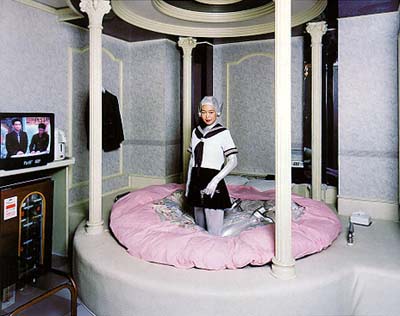
Before what I swore was no more than an instant, the ex-boxer was talking about love hotels, the fascinating, neon-pulsing establishments that let Japanese couples escape their domestic digs for an hour (or a full night) of lusty lovey-dovey. Usually, these hotels have mirrored walls, vibrating beds, TVs with a single channel that always moans, and enough prophylactics and lubricants to allow a baby calf to re-enter its mother's mommy cave should he choose to hide from a veal farmer.

"I love love hotels," he declared.

I love the way that sentence sounds, I thought.

"Why do you like them so much?" I asked.

"They are cheap!! Ice and Cream off Rt. 18 only costs 5,000 yen (about $45) for one room per night! Also, they are fun." He said this matter-of-factly and then unrolled a big grin. The winter surfer laughed. The ex-boxer leaned in closer to the heater and the rest of us. He continued.

"And, they are good for many girlfriends!" He leaned back, and, satisfied, he folded his arms across his chest like he just pulled a difficult block from a Jenga tower without collapse. I became more interested in the conversation--the air of relaxation in the room, around the heater, was now palpable and I could tell the men wanted to open up and talk, wanted spill beans that rarely, if ever, get to be spilled.

"Go on!" I urged. "You can't just say something like that and stop!"

"Well, I live with my family so I never have girlfriend to my house. But...even if I live alone, I still will go to love hotels! Because if I have a girlfriend to my house, I can only have one girlfriend. I don't like this. With a hotel, I can meet different girls when I want."

"Four? Five? Seven?" The winter surfer practiced his counting and contributed to the conversation at the same time--moments like this inspired him to keep coming to English class each week. The family man chuckled.

"Well, a few. Four now, I think. Sometimes, I change girlfriend. I like different types of girlfriend. For example, young girlfriend, old girlfriend, and sometimes married girlfriend!"

We all started howling.

I felt a little guilty laughing and I couldn't help but think of the husbands, out there somewhere, who kiss their wives and detect faint scents of another man, of this man sat before me, on the clothes of their spouses, on the headrests of their cars, on their pillow cases.

"Last year, for example, I had two girlfriend in Toyoshina. One girl was a high school student, 18-years-old, and one girl was a woman, 47-years-old."

At this point, my jaw was on the ground seeing as I teach high school students and couldn't possibly imagine any of my students peeling their little faces away from their textbooks long enough to utter a single "Konnichiwa" to the stocky ex-boxer. I also wondered if this man had just confessed to committing some sort of crime. Again, the man leaned in close to the heater and started speaking with a whisper as if the walls have ears.

"Oh, Andrew, I have a question. The 47-years-old woman, she used to meet me in a parking lot in Saku. She used to...uhhh...I don't know in English." He starts gesturing with his hand near his crotch. "She gives a...uhhh... handshake?"

We all laughed--I because I knew he made a mistake with his English, the other two men because he gestured with his hand near his crotch.

"No no no!! Not handshake! This is handshake!" We shook hands. "In English we call this," I imitated his gestures, "We call this a 'hand job'." Before I could finish digesting this thought--I am, at this moment, getting paid to teach the difference between a hand job and a handshake to three grown men sitting around a heater in a cold garage in Japan--the ex-boxer continued.

"And what do you call a mouth...a kind of mouthshake?" He gestured with his hand, opened his mouth like he was going to scream, and bobbed his head back and forth. The other two men erupted with laughter. "A mouth job?"

"Hahaha. No, not really. We call that a 'blow job' in English. 'Blow. Job'."

"Ah ha! Blow, like a wind blow? Ah ha! Blow job, hand job! Blow job, hand job." The two other men repeated after him and practiced their pronunciation like new converts learning from a proselytizing adult film star.

Sunday, February 25, 2007

An Amazing Guy

Need some inspiration? Counting dustballs on your desk at work? Here you go, inspiration free of charge!

The amazing guy (in a nutshell): His name is Conor. He traveled around the world on a 2 year trip. During the trip, he volunteered at an orphanage in Nepal and connected with the children. After he finished the trip, he returned to Nepal to open up an orphanage of his own that now protects about 20 children who were once trafficked. He's in his early-thirties and has no monetary income. He had no previous experience with working in/setting up an orphanage---he simply saw a thing that needed fixing and leaped.


This link will take you to a page with pictures of Conor, the orphanage, and the kiddies.

http://blogs.bootsnall.com/conor/?p=369#more-369


You can also donate to his orphanage via the blog.

Leap.

cheers,

A

"I Prefer Not To"


left: This picture has absolutely nothing to do with this post---I was trying to see if I could figure out how to post larger pictures because my snowboarding pictures (previous post) came out small. Ignore this picture...ignore it now!

Every year, there is a prefectural English camp held in Nagano prefecture. Two hundred students attend along with 60 JETs and Japanese English teachers. In a country in which people visit the dentist four or five times in a two week period for a collective hour or two of dental work simply because “it’s the Japanese way,” a place wear senseless paperwork and long, suicide-inducing work hours have swelled to mythical proportions, planning such a camp would require countless hours of cutting through administrative red tape, submitting expense reports, emailing JETs, emailing more JETs when JETs you had been counting on decide to cancel, etc. Keep this in mind as you read on.

Today, a teacher in my office, a man with over 35 years teaching experience and an educational bag-of-tricks the size of a flea turd (OK class, I hope you're ready to dream and drool because it's lecture time...again), a man who, as unfortunate as it is predictable, sits on the prefectural board of English teachers, tip-toed up to my desk and smiled and laughed instead of saying, “Excuse me.”

Smile. Laugh. I turn to face him. “Uh Andrew, the English board had a meeting recently about the prefectural English camp." Smile. Laughing. "So…we were wondering if you and Natalie would like to plan the camp this year.”

I laugh at the silliness of his request. He fails to remember that we have already planned two camps this year for our school, we planned one last year, and the previous Assistant English Teacher (AET)planned the prefectural camp two years ago, making our school next to last in line for the responsibility.

“Hmmm. I really, really don’t want to plan that camp. When I first arrived in Japan, everyone warned me about getting coerced into planning it and said it was a paperwork nightmare. Plus, we already planned two camps for our students this year. Yeah, if possible, I’d prefer not to.” I love using that classic Bartleby line in situations like this.

He laughed. I tried to explain myself some more. He tried flattery (“Well we just thought you and Natalie had so much practice with the camps at this point and you are such strong AETs that it wouldn’t be too difficult for you”) and, after making me feel guilty for refusing—or “preferring not to” to do the camp—he eventually agreed to ask an AET husband-and-wife team who have helped with prefectural stuff in the past.

Later that day, I asked my supervisor if she thought my refusal was inappropriate or not.

“Oh no no no. It’s fine if you guys don’t want to do it. You have already done a few camps and another AET who doesn’t have to organize any camps can do the prefectural camp. But I think many teachers on the English board have heard great things about you and so they have high expectations of you. You don’t have to live up to those expectations if you don’t want to.”

Huh? This is a classic example of Japanese doublespeak! Basically, it’s OK if I don’t want to do the camp, but I will not live up to the expectations of senior teachers (most of whom I’ve never even met). It’s common for a Japanese person to avoid saying “No” by saying something like “ "Hmmm, maybe that will be difficult.” I feel like I’m accustomed to this sort of hide-your-true-opinion communication, but her comment caught me off guard.

This little episode reminded me of a time I went out to eat at a cheap casino in Reno with my extended family. We only decided to go out to eat because my uncle raved about some $2-3 dinner special the casino served (they try to lure in gamblers by offering cheap food and putting restaurants in the back of the casino so you have to walk past gaming tables to eat). When we arrived, all of the kids started drooling over various expensive dishes on the menu. With wide eyes, I blurted out, "I want the steak!" My uncle said, "You can get whatever you want, but we came for the special."

It's the same idea----do what you want but...also follow expectations.

Pride and Spirit! Pride and Spirit!

Last night, sweaty and flushed after a soak in the onsen, I met a man in the lobby of my gym. He stared at me as I passed and then blurted, “Hello. English?”

I stopped with my arms full of shoes, a sweatshirt, and my gym bag.

“Hello,” I said.

My answer was all he needed to hear.

“Just a minute,” the man said in Japanese.

He pulled out a small notebook and started frantically flipping through the pages. Sitting to the left of us, two old women with beet-red faces cooled down from their dips in the onsen and looked on, amused that a Japanese person was attempting to make contact with the tall, white, silly creature they often see but never dare address. The man finally found the page he was looking for.

“This,” he pointed to the top of the page. “In English? Uhh…you say? In English?”

The words “Pride and Spirit” were written in shaky script above many lines of Japanese. I looked at the man and smiled. This sort of thing happens on occasion in Japan, a country bloated with foreign English instructors. People see white skin and assume it belongs to an English speaker.

I pointed at the words and used my ESL teacher voice—something that sounds like the voice a parent uses with a toddler (minus all the cooing and pet names.)

“This says ‘Pride and Spirit,’ ” I said clearly. Before he asked me to, I repeated it two more times, “Pride and spirit. Pride and spirit.”

The man repeated after me and used gestures to explain that he was a singer and ‘Pride and Spirit’ was the title of a song he wrote. He pointed to the lines of Japanese verse below the title and I could see that the words ‘Pride and Spirit’ were written in as a chorus throughout the song.

“Sing? Pride and Spirit? Like this,” the man said. He started singing “Pride and Spirit! Pride and Spirit!” off-key and heavily accented in the gym lobby. The two old women laughed and the receptionist acted like nothing was out of the ordinary, like the lobby doubled as a concert hall a few times a day without notice.

“No, no,” I said, laughing, “I’m a bad singer. Very bad.”

The man insisted. “Please, you sing. Pride and spirit.” He jabbed his finger at the phrase in his notebook over and over again like a preacher with his bible. His request turned into an order, “You sing. You sing this.”

I looked around. People were coming and going. The old ladies were staring as if they were observing some strange social experiment that could explode in flames or morph into a foreign dance or display of culture at any moment. The receptionist pretended to be interested in her sign-in sheet but I could tell she was listening, waiting.

Tired and ready to go home and eat, I said frankly, “I’m sorry. No. I’m a bad singer.”

The man stared at me with a flat, unshaken expression on his face. My answer was not received or even understood.

“Please, you sing.” He smiled.

Sing or not sing. Sing or not sing. Hmmmm.

Oh fuck it, I thought. Singing the damn thing will be easier than getting my point across to this man—the path of least resistance.

“Priiiiide and spirrrrrit. Priiiiide and spirrrrit,” I sang, feeling faint from the immediate rush of blood to my blushed cheeks and forehead.

The man clapped and said, “Amazing! Amazing!” in Japanese and then tried to imitate my pronunciation and pitch.

“Nice to meet you,” I said and we shook hands.

I walked away and left him singing to his small audience.